Sunday, September 14, 2008

Smell of Sulpher

Those of you who read the Sept. IW may have noticed the unsigned opinion piece on page 11 titled Nationalization Controls Venezuelan Workers. And if you know anything about the history and current situation in Venezuela you may, as I certainly did, have problems with the main thesis of the piece and with some of the "facts" as presented. Take for instance this analysis concerning the re- nationalization(and socialization) of many key industries, industries that not so long ago ,in fact, belonged to the people( that is, the State) of Venezuela.

"However,the concentration of economic and political power in the hands of the President is worrisome." Well, it would indeed be worrisome were it true, but the fact that many industries and banks are being nationalized does not automatically transfer "economic power" into one mans hands. It should be mentioned that there is also a legislative body, courts, and a huge electorate which share power in a balanced fashion. Witness Chavez's loss at the polls with the last referendum. And his acceptance of that loss. Were he the dictator he is here made out to be would he call for elections on each of these reforms? Does the (unknown) author assume Chavez makes Castro like decisions over every aspect of economic planning or holds personal title to all these industries?

Then there is this observation: "His rhetoric and actions have polarized Venezuela into the unfortunately familiar 'us and them','patriots and traitors' model of social control." Anyone with the slightest historical knowledge would know that Venezuela's "polarization" began in colonial times and is very much a socio-political split between haves and have nots, light and dark skinned, in other words between those who controlled the oil wealth (with the blessing of the USA) and those who were left hungry and illiterate in the barrios and favelas. The flames of polarization are fanned daily by the hard-right and their American allies.


The really troubling aspect of this critique, from a Wobbly point of view, is the analysis of the 2002-3 CVT (oil workers union) strike which was designed to bring down the fledgling Bolivarian Revolution and restore right wing, privitized ownership of the oil sector. This is the authors take:
" The crushing of the strike sent a message to the rest of theVenezuelan working class:be an ally of Chavez or face overwhelming repression."

I have been fortunate enough to have been able to travel to Venezuela with a Witness for Peace delegation and to interview leaders of the CVT as well as academics, human rights activists and other non-partisan observers of the strike and as hard as this might be for the editor of the IW to face, the reality is that sometimes the workers can act in allegiance to reactionary, regressive forces. They may act out of bourgeois self-interest, they may aid in upholding an oppressive regime, they may, like Mr. Block, just be ass kissers for the boss. The cops beating the strikers are workers! What is missing from the article and the authors perspective is any historical context, any mention of CIA involvement in the strike, any mention of the right-wing orchestrated coup attempt just one year before or the atmosphere which led to the strike. What I heard from my conversations with Venezuelans was that the oil workers were a very elite sector,making many times the average wage,and that their union was top-down bureacratic and very much in support of the status quo. Far from a message of fear, what was sent to the working class was a message that a new economic as well as social order was being built, an order which promised a much fairer distribution of wealth for the multitude that had been excluded up till then. What was promised was a revolution which would turn the entire continent upside down, one with a much broader democracy to include indigenous people and those of African descent.

I would hope that our organization would encourage a more nuanced, particular, and historical analysis of current events and not rush to reflexive, doctrinal judgements such as these. What do others think?

Dave Jones aka troutsky

Thursday, July 31, 2008

Thoughts from Raoul Vaneigem on the Spectacular-Commodity System


"Haven't you ever felt like flinging your pay check into the face of the pay clerk? In that case, you have realized that:

  1. The wage system reduces the individual to a bookkeeper's digit. From the capitalist point of view, a wage slave is not a man but an index of the overheads of production and a certain degree of purchasing power in terms of consumption.
  2. The wage system is as much the keystone of global exploitation as alienate labor and commodity production are the keys to the spectacle-commodity system. To improve it would be to improve the exploitation of the proletariat by the bourgeois-bureaucratic class. One can, therefore, only do away with it entirely.
  3. Wage slavery requires that we sacrifice over eight hours of our days for eight hours of work: in return we receive a sum of money which covers only a fraction of the work done. The rest is retained by the employer for his own benefit. In its turn our wage has to be exchanged for polluted, junk products, household goods sold at ten times their real value, alienating gadgets (the car that enables us to get to work and consume, pollute, destroy the countryside, and save some empty time and kill ourselves. Not to mention the dues owing to the State, to experts, and to the trade union racketeers...
  4. Anyone who believes that wage demands can endanger private or State capitalism is mistaken: employers award to their workers only that increase which the unions need if they are to give evidence of their continuing usefulness: and the unions demand of the employers (who can, in any case put up prices) only sums that pose no threat to a system of which they are the greatest beneficiaries but one.
So you see, you have had a bellyful of living most of your life as a function of money and of being reduced to obedience to the dictates of economics, of merely existing and not having the leisure to live life to the full. Already, consciously or otherwise, you are fighting for a reallocation of useful goods which will no longer have anything to do with the pursuit of profits and which will, instead, answer people's real needs."

"Contributions to The Revolutionary Struggle," Raoul Vanegiem

Wednesday, July 16, 2008

Look For Me In Butte

One of the reasons for my joining the IWW was to challenge the dominant notion that, to qoute Margaret Thatcher, "There are no alternatives". I find the rigid, thoughtless, conformity of Americans to be a terrifying threat to democracy and justice for workers and so was heartened to find a group willing to step out of the mold and proudly proclaim it's difference. Therefore, when I walked up to the Union Corner in Butte last Friday and saw the IWW banner hanging there and my Fellow Workers wearing the Black and Red, I reflected on just how far we had come in so short a time.

Here was the very "alternative" Margaret said didn't exist! And what a perfect backdrop for our message of worker solidarity to resonate in, Butte America, with both it's historical connections to the IWW and it's present-day economic woes. Due to the predatory, boom and bust nature of advanced capitalism, the boarded up buildings and ever-present "for sale" signs spoke volumes about the struggle the people of this mile-high city face to put food on their tables.And here in the middle of it was a group of folks ready to talk about alternatives, resisting that conformity, unwilling to "go along to get along".

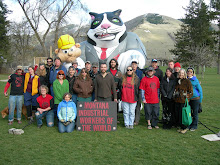
Whether sitting at the table selling shirts and books or sitting listening to the great old songs or just wandering the festival grounds those three days, I was constantly approached by people who wanted to learn more about what we stood for and what I thought and how the world might be changed for the better.People who saw us proudly wearing our Frank Little shirts (fantastic job, Dennis!)were inspired to tell us their stories and talk about unions and think about WORK. One shy young teenager approached me and said he had just started reading about socialism.Another guy came up to say he had seen our booth and gone home to dig up his grandfathers old union card, which he then proudly showed us. As my wife and Vicki were headed for the gospel tent a man called out "hello Sisters" and showed them his IWW pin. All weekend people tapped me on the shoulder and asked me "who was Frank Little?" or said "I didn't know the Wobblies were still around" and were genuinely interested to hear of our activities.One guy even wanted to talk about Gramsci and Guy Debord! (a theory wonks dream come true!) It is because there is a latent but ever-pressing yearning for deep, structural change that working folk are relieved to see we are still around. As the crisis of capitalism worsens (and it is going to worsen),this yearning can be channeled into organized effort if we stay on task, keep improving our own democratic processes and build our capabilities. Keep up the good work, Wobblies!

From Dave

Saturday, May 17, 2008

Fire the Boss and Get to Work!

Coordinators, facilitators, and leaders have a tendency to coordinate, facilitate and lead. Well, therein lies a problem. What do we do when we begin to depend on others to ensure that the difficult work of organizing society gets done? Well, do we depend on others? Please note that I'm playing around with self-evident, rhetorical ideas. That is because I'm curious about the quiet manner in which we slip into roles as we organize for a future where we hope to be more relevant. As a Wobbly, I was attracted to the Industrial Workers of the World because I hoped it would give me more power over my own life. In many ways it did, but it hasn't be given to me by the IWW. In the end, I realize I had to become more self-aware, take risks and I had to get the work done instead of waiting for others to do it for me.

My experience with leadership within grassroots organizations has shown me that a tendency in our society is to be "party" but rarely "participant." The "party" version usually comes in the form of donations. That is because members of grassroots groups often assume the work is going to get done by someone. That is because visible leaders, coordinators, and facilitators emerge to reassure us that someone out there is taking care of business. Perhaps a lack of powerful, identifiable leadership helps explain why the Industrial Workers of the World may seem disorganized. However, the IWW intentionally avoids a monolithic directorate...that is because it's up to us to educate ourselves, organize ourselves, and most importantly, to act for ourselves.

So what do we do to address the lack of historical agency prevalent in our society? Someone's got to bring the ideas forward, right? Or do we wait until people can no longer tolerate the way things are to spring forward with an alternative? It would seem to me that waiting would run a massive risk of inviting reactionary ideas to come to the aid of desperate people. But getting motivated, staying motivated despite constant setbacks and disillusionment, and taking a role doesn't have to be someone else's reality. Can't it be our reality too?

Of course, this doesn't mean acting in an individualistic, self-centered manner, but one that honors and respects one's own interest while appreciating that an injury to one is an injury to all. Therefore, collective harmony will more often than not result in individual harmony. How could it not when one appreciates the inter-dependent nature of life?

Another fear that often prevents us from acting, speaking out, etc. is the fear that we don't know what the best course of action is and we fear the judgments of others. The IWW is often dismissed as an irrelevant response to the problems we face, yet something draws us to it. But it is massively important that we move beyond an intuitive sense that the IWW is offering something unique, or something that sounds ideal, and actually study it. We should know what the IWW is trying to do. We should know what the historical basis for its plan is. And, we should agree that, while not perfect, this plan for organizing society is worth our best efforts and continued sacrifice.

Finally, we need to be reassured that the people with whom we are struggling--and taking risks--are people we know and can trust. So working on our personal relationships within our organization becomes tantamount to a genuine, cohesive and solidaritous struggle.

All of that said, we are brought back to the original point of this discussion: what about leaders? I do believe some people sometimes emerge as something we have termed "natural leaders." But why is this? Does this imply that the rest of us are "natural followers"? I'm curious about human history and our limited understanding of human nature. Is it natural for some to lead and others to follow? Or is this the result of thousands of years of human evolution based on the idea that hierarchy is natural? Is there a natural necessity for some to lead and some to follow? Can we imagine and reflect on this concept outside our intuitive reactions to this idea?

I'm not convinced that leadership is natural. And even if it were, is it desirable? Either way, the tasks at hand affect us all and I would think that one would relish the reality that their life is not pre-determined and that one has the opportunity to make their own history and shape their own life and construct their own knowledge. But developing such agency requires taking some risks and realizing that saying we need to work together to accomplish our hopes of a brighter future is much easier than actually picking up the tools and getting to work.

Edward Gibbon, the author of The Decline and Fall of the Roman Empire, once wrote "Augustus was sensible that mankind is governed by names; nor was he deceived in his expectation, that the Senate and people would submit to slavery, provided they were respectfully assured that they still enjoyed their ancient freedom."

I believe one of our amazing unions most fundamental roles is to smash hierarchy! Perhaps even before we talk of tackling capitalism. Of course, we should work on both concomitantly. But I honestly believe capitalism is born from the historical role of domination that springs forth from hierarchy. We must look at our social relationships. We must look at our dominion over nonhuman nature. We must look at our social interactions. We must look at the ease with which we slip into roles that we rarely determine are necessary and ethical.

So let us begin a discussion of the need for each of us to accept our ontological vocation of becoming subjects not subjugated. Let us enjoy the fruits of mutual aid as we become agents in the shaping of our own lives and no longer be the slave objects of the powerful forces to whom we've relinquished our agency. In other words, pick up a machete and start clearing your own path.

Tuesday, May 6, 2008

Carla

Cool,

I just figured out about how to get in here. So now that I am here, I guess I had better think of something intelligent to say.

So, we get so busy talking about how to save the world and going in so many different directions, as we all are, that it is easy to forget about our own real life battles. I just love the meetings and the energy. It has been a whole lot of fun so far, but I am wondering what the Heck I am doing here, and already I am chairing meetings. Whooooa horsseey. I am not so sure yet. First of all, I am the boss and the worker. My wage is being set by the market, which I am not sure about. I am a massage therapist. I am trying to figure out if there is a way for me to utilize this group. The truth is, as I see it, that there is a massage school in town that does massages for CHEAP! So I don't know if there is anything to do about it.

So, I am not sure I have a group to bring together.

I am not so sure if it is in my own best intrest to be putting tons of time and energy into a cause that I am not so sure that I am going to benefit from.

I am not saying I am bailing, but I need to make sure that I get the bills paid, and that I am networking where it will do me some good.

I know that this sounds awfully egocentric, but it is also realistic. After all, How can I save the world if I can't save myself?

I guess that this is part of the new direction and vision. Maybe I am not alone questioning, what the hell I am doing, all of the sudden identifying myself with this eclectic, strange, awesome group of people . Especially,if we don't have a teacher's union, or a electrician's union, or a carpenter's union to protect.
I feel like I am not really ready to jump totally into the fold with all four feet. I need more time to be able to be a part of the group with full integrity.

Like I took years to gather the information I needed to decide whether or not we should go to war with Iraq. I feel like I am mainly there for because I feel like there are a lot of very worldly people who have a lot of first hand information. I feel like a new born baby, just opening my eyes for the first time to a whole new world.

You will have to be patient with me while I decide whether I want to wear Wobblie all over me all of the time, or even some times. I don't like the shirts. Saying I'm a wobblie feels exilerating and very odd at the same time.

Just a reality check.

Carla

Friday, May 2, 2008

Argentina's Recuperation Movement: The struggle to work without a boss continues

Apr 30, 2008 By Marie Trigona

Marie Trigona's ZSpace Page / ZSpace

Who wants to work for a boss? I'm guessing that most people would say no. Since the birth of capitalism, workers' movements have pondered the utopian dream of liberating the working class from exploitive bosses. Argentina has been home to a phenomenon called recuperated enterprises. When the owner decided to shut down a factory or business, workers decided to save their jobs and physically occupy their workplace. Overtime the worker takeovers caught on. Today more than 200 worker run businesses are up and running. In the very heart of Argentina's capital Buenos Aires, workers at a 20 story hotel are making this utopian dream a reality.

Walk into the BAUEN Hotel, and most guests are astounded by the 70's inspired d?r. The BAUEN hotel operates like any other hotel, but with one big difference. There is no boss or owner. Guests appreciate the hotel's convenient downtown location and cultural events. Locals also enjoy the BAUEN's newly renovated front caf?alled Utopia.

But things weren't always bustling at this starlit hotel. Mar?del Valle, a BAUEN worker recalls the workers' decision to occupy the abandoned hotel. "Sometimes, I ask myself why am I here? We were able to recuperate a 20 story hotel, 220 rooms, 7 salons, a theater-bit by bit. The first carpets we cleaned with scrub brushes on our hands and knees. A very small group of companeros."

In the midst of Argentina's worst economic crisis in December 2001, the hotel was ransacked and remaining workers were fired by the former owner Mercoteles. A group of 15 workers along with supporters took over the hotel on March 28, 2003.

Arminda Palacios is a seamstress who has worked at the hotel for over 20 years and was there when the workers who decided to cut off the locks on a side entrance into the hotel during the initial occupation. "Us workers and all of our supporters we entered the hotel through the entrance on Corrientes Ave. The workers' entrance was on Corrientes. We simply entered. There was a small lock. They cut the lock off and we walked in. We went to the reception area. When we saw there was electricity, we didn't think there was going to be electricity....we started to hug and cry."

The BAUEN Cooperative recently celebrated their 5 year anniversary of workers' self-management. But the celebrations were bittersweet. The BAUEN cooperative, like many of the recuperated enterprises, was forced to set up shop without any legal backing whatsoever.

After 5 years, the Cooperative still has no legal standing and faced a court ordered eviction notice last year. Manuel Benitez, a cooperative associate at the hotel says that despite legal support, the public still supports the workers rights to defend their jobs. "A judge has ruled that the hotel should be handed over the original owner Marcelo Iurcovich. With the eviction notice, they gave us 30 days. We did many actions with organizations. We're still here thanks to the organizations and demonstrations held in the street in front of the hotel. We've appealed the eviction notice, but the appeal has been delayed. Once the appeal decision comes, I don't know what is going to happen. We're here because of our support from the public."

When the eviction notice arrived in July, 2007 - thousands mobilized not only against the eviction, but for a long term legal solution for the hotel. 150 workers are currently employed at the BAUEN cooperative. "During my 20 years working at this company, I got to know the bosses well. For us negotiation has been a bad word, and much more right now. We don't have to negotiate with them! Because the BAUEN is ours, even if the bosses don't like it!" That was Arminda Palacios again, a 68-year old worker and cooperative advocate, at an assembly held shortly after the eviction notice was delivered.

The eviction notice came in response to a petition by the Mercoteles group, which the court recognizes as the legal owner of the property. Appearing in court in 2006, Marcoteles Director Samuel Kaliman was unable to provide the court with Mercoteles' address, board member names and other legal information.

The federal court has accepted a appeal on behalf of the BAUEN cooperative which has temporarily delayed the eviction order. According to Federico Tonarelli, Argentina's worker-occupied factories which provide jobs for more than 10,000 people need a definitive legal solution. "The recuperated enterprises don't have a definitive legal framework. A national expropriation law would not only provide workers with the legal right to the buildings, but a framework for all the recuperated enterprises."

Back at the hotel, the 150 BAUEN cooperative associates continue to reinvent social relations and reverse the logic of capitalism. Marcelo Duharte has worked at the BAUEN for over 20 years. He says that the workers are accomplishing what capitalists are not interested in doing, creating jobs. "Even though the recuperated enterprises are just a grain of sand, we're changing small things, not everything that we would like to. Slowly were incorporating a new concepts. Not just workers taking over property, but we're creating another economy and making our lives more dignified through work. If the state doesn't implement policies to create jobs, there are workers with their humility, transparency and honor implementing a new philosophy for work."

Despite market and legal challenges, the BAUEN cooperative continues to improve services and open its doors to other workers challenging the system. Human rights activists, unionists and community organizers regularly use the hotel's facilities for meetings and events. Argentina's worker occupied factory movement is rallying across the country for a national expropriation law in the face of eviction orders and legal uncertainty. At a massive rock concert held last year, thousands voted to resist against a forceful eviction of BAUEN and other occupied factories.


Marie Trigona is a writer, radio producer and filmmaker based in Buenos Aires. She can be reached at mtrigona@msn.com

Tuesday, April 15, 2008

Reform or Revolution?

We have been having some great discussions at the last few meetings ( this is subversive activity in itself!) about some aspects of the IWW program and the classic question keeps cropping up. To what degee can we work within the current system for change and to what degree should we totally reject the systems processes and mechanisms? After all, we are plenty aware of capitalisms ability to devise ways to reproduce itself and co-opt attempts at radical change. Control of popular culture, the media, education ,religion, even the boundaries and limits placed on permissible debate or discourse in civil society , all these things subtly align a dominant narrative which sustains capitalism. Can we change things through electoral politics? Should we work for social justice through non-profit organizations? Will incremental change do any good? Can we build a popular movement or just a dedicated vanguard?

Better minds than mine have wrestled with these questions for two centuries but I believe modern times require what is now called "multi-tasking". We should work to build a "popular front" on many levels with allies all along the political spectrum but I believe the most necessary, critical ,and presently lacking political identity in such a front is the left-Left and those with the courage should strive to re-fill this niche. By staking out a radical position, uncompromisingly anti-capitalist, we create political space for everyone, the very thing capitalism hates. If you wish to vote and it helps build trust with allies, fine, but be ready to argue in every conversation that direct action is the only real way individuals become agents of change and that the economic system is the thing that must be replaced.

I say we reject the either-or constraints and work for both reform and revolution, dividing our precious time among those tasks which will bear the greatest fruit. Reform is easy and many choose that road of quick results. Lets get food to poor people. Lets get health care for all. But building the foundation for deep, structural, long term change requires patience and energy for which regrettably few have either the stamina or courage. This is where we are most needed. Let this be our primary task.