Showing posts with label IWW. Show all posts

Saturday, May 17, 2008

Fire the Boss and Get to Work!

Coordinators, facilitators, and leaders have a tendency to coordinate, facilitate and lead. Well, therein lies a problem. What do we do when we begin to depend on others to ensure that the difficult work of organizing society gets done? Well, do we depend on others? Please note that I'm playing around with self-evident, rhetorical ideas. That is because I'm curious about the quiet manner in which we slip into roles as we organize for a future where we hope to be more relevant. As a Wobbly, I was attracted to the Industrial Workers of the World because I hoped it would give me more power over my own life. In many ways it did, but it hasn't be given to me by the IWW. In the end, I realize I had to become more self-aware, take risks and I had to get the work done instead of waiting for others to do it for me.

My experience with leadership within grassroots organizations has shown me that a tendency in our society is to be "party" but rarely "participant." The "party" version usually comes in the form of donations. That is because members of grassroots groups often assume the work is going to get done by someone. That is because visible leaders, coordinators, and facilitators emerge to reassure us that someone out there is taking care of business. Perhaps a lack of powerful, identifiable leadership helps explain why the Industrial Workers of the World may seem disorganized. However, the IWW intentionally avoids a monolithic directorate...that is because it's up to us to educate ourselves, organize ourselves, and most importantly, to act for ourselves.

So what do we do to address the lack of historical agency prevalent in our society? Someone's got to bring the ideas forward, right? Or do we wait until people can no longer tolerate the way things are to spring forward with an alternative? It would seem to me that waiting would run a massive risk of inviting reactionary ideas to come to the aid of desperate people. But getting motivated, staying motivated despite constant setbacks and disillusionment, and taking a role doesn't have to be someone else's reality. Can't it be our reality too?

Of course, this doesn't mean acting in an individualistic, self-centered manner, but one that honors and respects one's own interest while appreciating that an injury to one is an injury to all. Therefore, collective harmony will more often than not result in individual harmony. How could it not when one appreciates the inter-dependent nature of life?

Another fear that often prevents us from acting, speaking out, etc. is the fear that we don't know what the best course of action is and we fear the judgments of others. The IWW is often dismissed as an irrelevant response to the problems we face, yet something draws us to it. But it is massively important that we move beyond an intuitive sense that the IWW is offering something unique, or something that sounds ideal, and actually study it. We should know what the IWW is trying to do. We should know what the historical basis for its plan is. And, we should agree that, while not perfect, this plan for organizing society is worth our best efforts and continued sacrifice.

Finally, we need to be reassured that the people with whom we are struggling--and taking risks--are people we know and can trust. So working on our personal relationships within our organization becomes tantamount to a genuine, cohesive and solidaritous struggle.

All of that said, we are brought back to the original point of this discussion: what about leaders? I do believe some people sometimes emerge as something we have termed "natural leaders." But why is this? Does this imply that the rest of us are "natural followers"? I'm curious about human history and our limited understanding of human nature. Is it natural for some to lead and others to follow? Or is this the result of thousands of years of human evolution based on the idea that hierarchy is natural? Is there a natural necessity for some to lead and some to follow? Can we imagine and reflect on this concept outside our intuitive reactions to this idea?

I'm not convinced that leadership is natural. And even if it were, is it desirable? Either way, the tasks at hand affect us all and I would think that one would relish the reality that their life is not pre-determined and that one has the opportunity to make their own history and shape their own life and construct their own knowledge. But developing such agency requires taking some risks and realizing that saying we need to work together to accomplish our hopes of a brighter future is much easier than actually picking up the tools and getting to work.

Edward Gibbon, the author of The Decline and Fall of the Roman Empire, once wrote "Augustus was sensible that mankind is governed by names; nor was he deceived in his expectation, that the Senate and people would submit to slavery, provided they were respectfully assured that they still enjoyed their ancient freedom."

I believe one of our amazing unions most fundamental roles is to smash hierarchy! Perhaps even before we talk of tackling capitalism. Of course, we should work on both concomitantly. But I honestly believe capitalism is born from the historical role of domination that springs forth from hierarchy. We must look at our social relationships. We must look at our dominion over nonhuman nature. We must look at our social interactions. We must look at the ease with which we slip into roles that we rarely determine are necessary and ethical.

So let us begin a discussion of the need for each of us to accept our ontological vocation of becoming subjects not subjugated. Let us enjoy the fruits of mutual aid as we become agents in the shaping of our own lives and no longer be the slave objects of the powerful forces to whom we've relinquished our agency. In other words, pick up a machete and start clearing your own path.

Monday, March 24, 2008

IWW Back in Montana!

WE'RE BACK!

Actually, we never fully went away. Even though the 1980's were some lean years for the Industrial Workers of the World in Montana, vestiges of our militant union have persisted since we first arrived shortly after the founding of the IWW in 1905. Wobbly organizers came to help organize the exploited miners and timber beasts of the rugged old west.

Missoula, Montana can proudly proclaim itself to be the site of one of the first free speech fights in the U.S. IWW organizers like Elizabeth Gurley Flynn came to Missoula in 1909 to speak out on the streets and to announce to the world that "the working class and the employing class have nothing in common." For exercising their rights to free speech, hundreds of Wobblies and working class men and women were jailed in Missoula. After overfilling the jail cells and having no where to put the overflow of free speech fighters and no way to feed them, a decision was made to just let them out. And that is how free speech as we actually understand it was born in this country, not through the U.S. Constitution! (Perhaps we have even more rights than we know, we just have never effectively exercised them...?)

Fast forward to July, 2007 when a couple of Wobblies met in the Break Expresso coffee house on Higgins Avenue and simply said: "Let's start a General Membership Branch!" And so, in six short months this goal was realized. We now have a branch and we are finding people everywhere that are interested in our work and ready to get organized. We are finding job sites to organize and we are finding enthusiasm for our radical critique.

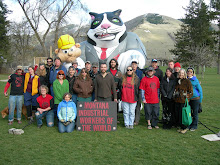
Over the past few months we've increased our visibility to the public by participating on a panel of international labor rights, a labor film festival, and a university film series. A standout event was hosted in Butte, America at the site of some of the IWW's most important history. This IWW social was recognized by the mainstream press on television, and state-wide papers. The IWW carries with it a great deal of meaning in the state of Montana, and so our return is big news.

On May 1 and 2, 2008 in Missoula we will be putting on two days of commemoration and celebration. On May 1, we will be participating in what is recognized around the world as the actual Labor Day. We will be meeting in Kiwanis Park at 5:30 PM for a commemoration of the Haymarket Massacre and International Workers' and Socialists' Day. From the park we will march to the University of Montana to watch a film appropriately titled "The Wobblies."

On May 2, we will gather at the site of the 1909 free speech fights in front of the Florence Building on Higgins Avenue for a re-enactment of those speeches and the reaction of the police. We will be joined by historians, poets, musicians and Wobblies that want to speak out! From there we are going to the Union Hall to host a Utah Phillips Benefit Concert. The headliner is "America's most famous unknown folksinger," Mark Ross.

Join the One Big Union today! If you are in Missoula, come to one of our meetings on the first Monday of every month at the Union Hall at 7 PM.

Don't wait any longer to wage slavery and take control over your own life.

Wobblies Launch New Chapter


Story available at http://www.billingsgazette.net/articles/2008/03/02/news/state/32-wobblies.txt

Published on Sunday, March 02, 2008.
Last modified on 3/2/2008 at 1:40 am

Wobblies Launch New Chapter
BUTTE - With an old, worn broom, Dennis Georg swept off nearly a foot of February snow that had accumulated on the grave of Frank Little.

It was just a small favor from one Wobbly to another Wobbly: Solidarity to the end.

Georg, as was Little, is a card-carrying member of a small but controversial union known as the Industrial Workers of the World (IWW). It was started in Chicago by a group of socialists and anarchists who wanted to unite all the workers of the world. They were reviled by many as subversives and Communists.

"It was once very dangerous to carry an IWW card," Georg said recently while in Butte.

The evidence of that danger was at Georg's feet in Little's final resting place at Mountain View Cemetery. Little came to Butte in 1917 to recruit miners to join the IWW. For his efforts, Little was kidnapped by masked men, beaten, dragged out of town and hung by the neck from a railroad trestle.

Little's grave is somewhat sacred ground for Wobblies. This is why the grave is one of the stops over the weekend for a gathering being held in Butte to celebrate the recent formation of an IWW chapter in Missoula.

"They want to come here because of all the labor history in Butte," he said.

Georg, 60, works as an electrician and has been a Wobbly for 17 years.

Kevin Curtis, 37, of Butte, who works in TV production and freelance movie filming, is one of six members of the IWW in Butte. He said the IWW requires at least 15 members in one city before headquarters will allow a local chapter. Curtis estimates that there are about 2,300 Wobblies worldwide.

He said membership tends to fluctuate. "The IWW's numbers seem to go up when the middle class is under attack," Curtis said.

Curtis and Georg say they would like to get enough local workers to join the IWW, so Butte can have its own chapter like Missoula. Curtis believes workers in a blue-collar town like Butte would benefit from the IWW's support.

"Like our motto says, 'An injury to one is an injury to all,' and we want to give workers a voice in the workplace," he said.

The IWW always has been known for its hard-line stand on worker solidarity. Members believe that all laborers should be united and that the real power should be in the hands of the worker.

Georg was wearing an IWW T-shirt that stated the union's uncompromising stance in plain English: "The working class and the employing class have nothing in common."

The early Butte Wobblies used to be the victims of violence in the early days of the movement, according to Georg. He said they had to be secretive about getting a copy of the IWW's newspaper, the Industrial Worker.

Georg said the carriers would keep a copy of the IWW newspaper folded in a copy of the Butte Miner.

"If a guy wanted the Industrial Worker, he would tell the paperboy, 'Paper, paper,' and he knew he wanted a copy of the Industrial Worker," Georg said.

Georg and Curtis still hand out fliers and try to interest people in joining the IWW. They say they are glad Missoula was able to organize a local chapter.

However, they would like to see the IWW allow them to form a regional chapter in Western Montana. Curtis said that because Montana isn't as populated as other states it is difficult to set up a local IWW charter.

"Montana is so sparse it (a statewide chapter) would be better for us," he said.


Copyright © The Billings Gazette, a division of Lee Enterprises.